Aesthetic Devices Pay for Themselves Faster Than You Think
Aesthetic devices are one of the strongest capital investments in aesthetic medicine — whether you're an established med spa owner, a surgeon or dermatologist expanding into aesthetics, an NP opening your first practice, or a medical professional ready to build something of your own. The revenue model is simple, the margins are high, and the payback periods are short. This guide gives you an honest framework to evaluate any investment before you commit.
A typical aesthetic device payment runs $800–$1,200 per month. Sell two packages and you've covered it. Everything above that is profit. This guide shows you exactly how the numbers work — by device, by volume, and by the realistic timeline most practices actually experience.
Quick Answer
With financing, most aesthetic devices are cash-flow positive from month one — a monthly payment of $800–$1,200 is covered by your first 1–2 package sales. The question isn't whether the investment pencils — it does. The question is which device fits your patients and how fast you want to grow. Use the calculator below to see the numbers for any device.
01
Why aesthetic devices are easier to justify than most capital investments
Think about how most capital equipment works in medicine. You buy it, you use it for procedures, and you get reimbursed at rates someone else controls. Margins are thin. Revenue is capped. Aesthetic devices are completely different — you set the package price, you control the margin, and there are no insurance schedules or billing complexity. A patient pays for a package, you deliver the treatment, and the revenue is yours.
Layer financing on top of that and the picture gets even cleaner. Your monthly payment is fixed. Your revenue grows as you build volume. In month one you might cover the payment and not much more. By month six you are generating three, four, five times the payment in monthly profit. The math is simple — and it works in your favor faster than most people expect.
1–2
Package sales to cover your first monthly payment — cash-flow positive from month one
$0
Consumable cost per treatment on devices with no disposables — pure margin
5–10×
Monthly revenue vs. monthly payment by month six at moderate volume
The real numbers
Gabriela Arriaga of Innovación Nutricional currently generates $40,000+ per month with a single LipoMax RF device — over 15 years and 5,000+ treatment cases. Silvia Garcia, NP of Acacia Med Spa generated $50,000 in her first month after adding LipoMax RF and LumiMax CO2. These are real practices, real packages, real patient volume.
02
The only numbers you actually need to know
Start with the punchline
Here is what the numbers look like in a real scenario. LipoMax RF, 8 packages per month at $2,500 each — $20,000 per month. In year one you generate $240,000 in revenue. That is the opportunity. The math behind it is simple — and the calculator in Section 4 runs it automatically for any device and any volume you choose.
Here's what it looks like in practice
A real example — LipoMax RF
Monthly payment
~$1,000
Month 1 — 4 packages
$10,000
$9,000 profit
Month 6 — 10 packages
$25,000
$24,000 profit
Payment covered from your very first package sale. Everything above that is profit — and it compounds every month as volume grows.
The inputs that move the needle most
- Package price. The single biggest lever. A $500 increase in package price at 8 packages per month adds $4,000 in monthly revenue and $48,000 over the first year. Price based on the clinical value delivered — not on what competitors charge.
- Packages per month. This is utilization — the variable most practitioners underestimate in month one and overestimate at peak. Model conservatively: 4 packages per month in months 1–2, growing to 8–12 by months 4–6. Use Month 3–6 as your planning baseline — and remember that with financing, even 2–3 packages in month one covers your payment.
- Your investment. Financing spreads the investment across monthly payments — a device generating $15,000/month with a $1,500 payment is a strong trade. Contact Estetique for investment and financing details on any device.
- Consumable cost. Devices with per-treatment consumables (needles, tips, single-use applicators) have a real variable cost per session that compounds at volume. A $40 consumable cost per treatment at 10 treatments per day is $400 in daily variable cost. Devices with no consumables — like LipoMax RF and LumiMax PL — have essentially zero variable cost beyond staff time.
What most projections get wrong
The real revenue ramp looks like this: slower in months one and two while you build patient awareness and consultation volume, accelerating in months three through six as word of mouth develops, and reaching stable volume by month six to twelve.
Building to full utilization takes time, marketing, and patient education. Use conservative Month 3–6 utilization as the baseline, with peak capacity as the upside scenario.
03
What the numbers look like for each device
Every Estetique device has a distinct revenue model based on package price and sessions per package. Here are the real numbers across all four devices at conservative and full-volume utilization.
Body contouring
LipoMax RF
Multipolar RF + Superpulse + Red & Blue LEDPackage price
$2,500
Sessions/package
8 sessions
Conservative/mo
$10,000
At full volume/mo
$30,000+
Zero consumables — pure margin on every treatment. Strong payback at any volume. Get investment details →
Laser hair removal
LumiMax PL
4-wavelength diode · 755/810/940/1064nm · All Fitzpatrick typesPackage price
$1,000+
Sessions/package
6 sessions
Conservative/mo
$8,000
At full volume/mo
$25,000+
High volume, multi-area packages drive fast payback. 20M shot lifespan — zero handpiece replacement cost for years. Get investment details →
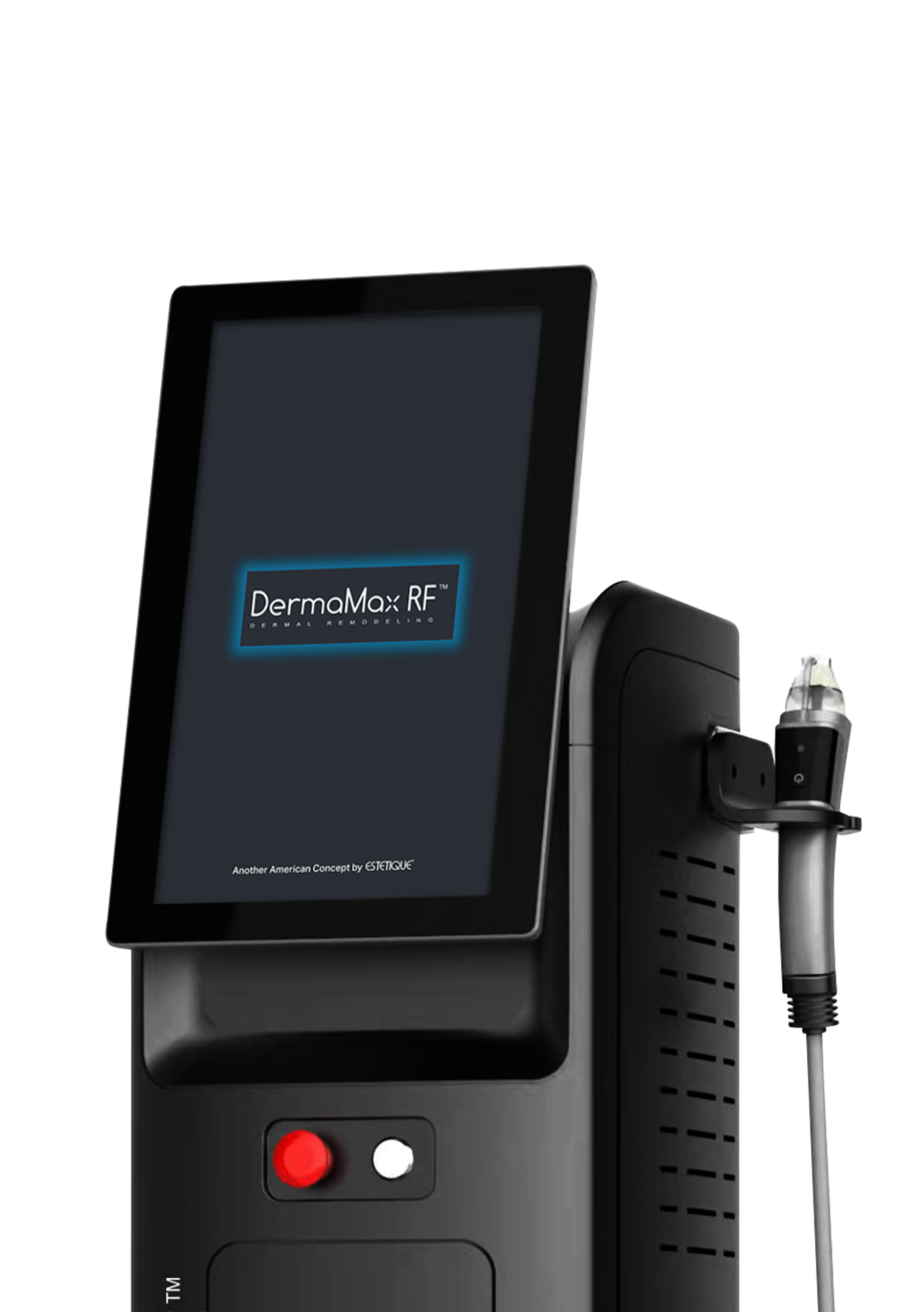
RF microneedling
DermaMax RF
Fractional RF microneedling · All skin types · Face & bodyPackage price
$1,200
Sessions/package
3 sessions
Conservative/mo
$4,800
At full volume/mo
$30,000+
Strong demand from GLP-1 and anti-aging patients. Higher per-session pricing possible at premium positioning. Get investment details →
CO2 laser resurfacing
LumiMax CO2
Fractional CO2 · 10,600nm · LumiLite protocol · Made in the USAPackage price
$5,400
Sessions/package
3 sessions
Conservative/mo
$16,200
At full volume/mo
$60,000+
Highest per-package revenue in the portfolio. Premium positioning, premium margin. Get investment details →
On package pricing
The numbers above use conservative package pricing. In established practices and premium markets, packages routinely command 20–40% higher prices — which means your payment is covered even faster. Price based on the clinical value you deliver, not on the lowest competitor in your market.
04
Run the numbers — interactive calculator
Select a device, set your monthly package volume, and see your projected monthly revenue, first-year profit, and payback period. Adjust the inputs to model conservative, moderate, and optimistic scenarios.
Model your revenue before you commit
Select a device and set your monthly package volume to see your monthly revenue, how quickly you cover your payment, and your first-year profit.
LipoMax RF
Body contouringPackage price
$2,500
Sessions/package
8
Packages sold per month
Monthly revenue
—
Payback period
—
Year 1 revenue
—
First-year profit
—
05
What does the first year actually look like?
The first year follows a predictable pattern for almost every practice. Slow to start, faster than expected by month three, and genuinely exciting by month six. Here is what to expect — and why the financing structure means you are profitable much earlier than most people assume.
Why financing makes the math easier than you think
Most practices finance their device rather than purchasing outright — and the monthly payment model makes the numbers much more straightforward. A typical financing payment runs $800–$1,200 per month. Even in month one, a single package sale covers your payment. Two or three packages in a month and you're already profitable. You don't need to recover the full investment before you start seeing returns — you just need each month's revenue to exceed that month's payment, which is achievable from the very first month for most practices.
What the first year looks like month by month
Whether you are adding a device to an established practice or launching your first aesthetic business, the ramp follows the same pattern. Practitioners coming from other fields often have existing patient relationships that accelerate volume. First-time business owners should plan conservatively and lean on the marketing support included with every Estetique device.
- Months 1–2: 2–4 packages per month. Building awareness, running initial promotions, first consultations. Payment covered by your first 1–2 sales. Volume is low — this is normal and expected.
- Months 3–4: 4–8 packages per month. Word of mouth begins. Before-and-after content driving inquiries. You are comfortably covering your payment and generating meaningful profit each month.
- Months 5–6: 8–15 packages per month. Referrals are flowing, marketing is working, patient compliance is strong. Monthly revenue is 5–10× your payment.
- Months 7–12: Stable or growing volume. Maintenance patients return, multi-area selling increases average package value. The device is generating strong monthly profit with minimal effort to maintain volume.
Marketing support is built in
Estetique provides clients with a complete bimonthly marketing content package — ready-to-post social media assets, patient education materials, and campaign content included as part of working with us. You are not starting from scratch. That support accelerates the ramp and reduces the time to reach consistent monthly volume significantly.
06
How to compare devices before you commit
If you are evaluating more than one device, compare ROI across three dimensions: payback period, monthly revenue ceiling, and revenue per treatment hour.
Covering your payment vs. long-term profit
Covering your monthly payment quickly is important — but so is the long-term revenue ceiling. A device that covers its payment in week one but has a lower revenue ceiling generates less total profit than one with a higher package price and slightly slower initial ramp. Compare both: how fast does it cover the payment, and what is the monthly revenue potential at full volume?
Monthly revenue ceiling
Some devices are fundamentally volume-constrained. A laser hair removal device at 150 beams per second has a higher throughput ceiling than one at 30 beams per second. A body contouring device that treats one patient in 45 minutes generates less revenue per hour than one that treats the same patient in 25 minutes. The revenue ceiling is a function of treatment speed, patient demand, and available appointment slots.
Revenue per treatment hour
Divide monthly revenue at target utilization by the hours required to generate it. This is the true productivity metric for a device. LumiMax CO2 at $5,400 per 3-session package delivers $1,800 per treatment session — potentially $900+ per hour for a 2-hour procedure. LipoMax RF at $2,500 per 8-session package delivers $312 per session — but sessions run 30–45 minutes, producing similar hourly revenue at high volume. Both are strong investments; the right choice depends on your practice model, patient demographic, and appointment structure.
07
The most common mistakes when evaluating an aesthetic device investment
Overthinking the math instead of starting
The most common mistake is spending months modeling scenarios instead of making a decision. The financing structure makes this investment lower-risk than it appears — your monthly payment is covered by your first couple of package sales, and every sale above that is profit. You do not need a perfect model. You need a realistic sense of your patient demand and a plan to market the treatment. The practitioners who generate the best returns are the ones who start, learn, and build — not the ones who waited for certainty.
Using peak utilization as the baseline
The most common mistake — and the one that creates the most disappointment. Building your model around 15 packages per month when month-one reality is 3 packages sets false expectations and makes the investment feel like it's underperforming when it's actually performing normally. Use conservative utilization for your baseline and let upside surprise you.
Ignoring the ramp period
Payback calculations that divide device cost by monthly revenue at steady-state volume and call that the payback period ignore the fact that months one and two generate significantly less revenue. A more accurate payback model accounts for the revenue ramp — lower in early months, higher as volume builds — rather than assuming full utilization from day one.
Forgetting financing costs
If you are financing a device, interest over the term is a real cost that affects your monthly cash position and overall return. Choosing a shorter financing term reduces total interest paid significantly. Estetique offers flexible financing options — ask about current terms when you book a demo.
Undervaluing no-consumable devices
Devices with no per-treatment consumables have a structural margin advantage that compounds at volume. A device generating $15,000 per month with $2,000 in monthly consumables nets $13,000. The same device with no consumables nets $15,000 — 15% more margin on identical revenue. Over a year, that difference is $24,000 in additional profit. When comparing devices, always calculate net margin, not gross revenue.
FAQ
Common questions about aesthetic device investment
Run the numbers — then book a demo
The calculator above gives you the model. A 15-minute demo gives you the real revenue numbers from practices like yours and honest answers about what utilization looks like in your specific market.